The Carburetor Shop LLC
204 East 15th
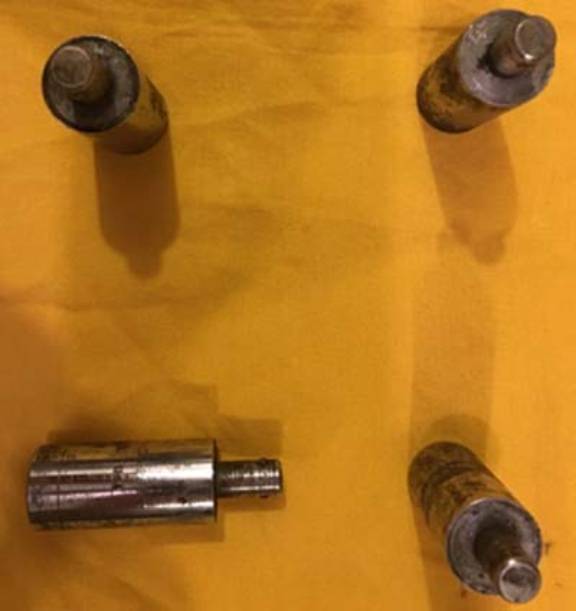
Street Eldon, Missouri 65026 Home | History | F.A.Q. | Orders | Contact Us | SELL TO US Carburetors | Repair Kits | Other Parts | Literature | Tools | Articles | Troubleshooting | Carburetor Identification Passenger Kits | Truck Kits | Tractor Kits | Industrial Kits | Marine Kits | Multi-carb set-ups Car Comics | Car Records | Car Trading Cards | Subscription Cards | Oakland and Pontiac Carburetor stands Some folks seem to think all they need to rebuild their carburetor is: the carburetor, a rebuilding kit, a few tools, and a bucket of evil-smelling liquid a.k.a. carburetor cleaner. I am going to suggest another requirement, equally important as any of the above.......................a carburetor stand. So why do I need a carburetor stand? There are many reasons, of which I will list a few. (1) safety - the stand acts as a third hand to help you hold the carburetor during disassembly. You are much less likely to have a screwdriver slip on a greasy screw, and perforate your hand, requiring a trip to the emergency road and a tetanus shot. (2) Ease of adjustment - with the carburetor off the workbench, all of the throttle linkage, fast idle linkage, choke linkage, etc. will function with ease, and final adjustments are easily made. (3) do no damage - one of the most important reasons to use a stand is to do no damage to the carburetor. On virtually all carburetors, at least some of the carburetor (throttle arm(s), choke housing, fast idle linkage, etc. extends BELOW the mounting surface of the carburetor. Virtually all carburetor throttle arms are pressed on to a flat surface of the throttle shaft, and some of the metal of the shaft is peened or staked over the arm to hold it in position. Ever see a carburetor with a loose throttle arm? And hear someone blame an offset throttle linkage? Ever think about the side tension applied to the arm by setting the carburetor on the work bench with no stand, and trying to disassemble the carburetor? Quite possible to loosen the arm where brass is the material of the shaft, bend the arm if the shaft is steel, or even bend the throttle shaft if a slab type shaft. Much more likely that loose linkage arm was caused by some previous "rebuilder" not using a stand, than by an offst throttle pull. Simply using a carburetor stand eliminates these issues. History The first carburetor stand of which I am personally aware are the individual chrome-plated steel legs introduced by Carter in the early 1950's.
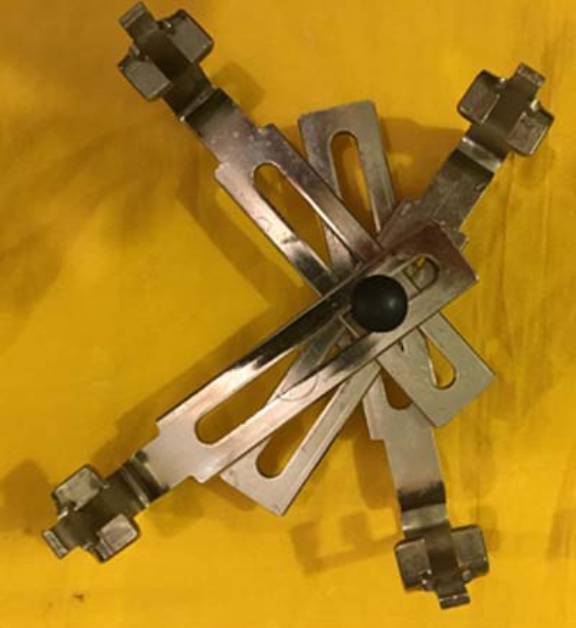
Some time after that, Carter superceded the individual legs by a metal adjustable stand:
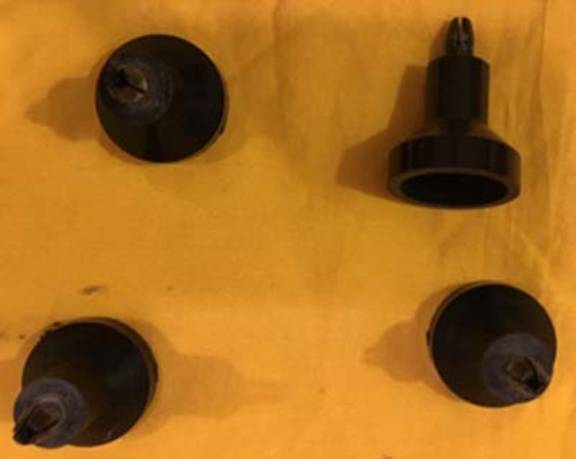
And of course the aftermarket came along with a cheaper alternative. Pictured here are individual plastic legs:
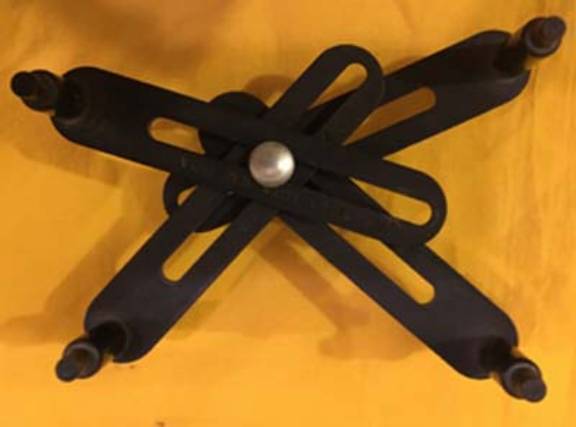
And an aftermarket plastic adjustable stand (I have had a couple of these break while using!):
And about this time, some might be thinking that the reason for the article is that I sell carburetor special tools, and am trying to drum up business. While it is true that I have a large collection of original carburetor rebuilding tools, and also have thousands of these for sale; I would suggest differently. Long before I found my first Carter tool kit, I saw the need for a carburetor stand, and made my own! And honestly, I would rather use these homemade stands (I have made several for use with different carburetor footprints) than any of the factory stands.
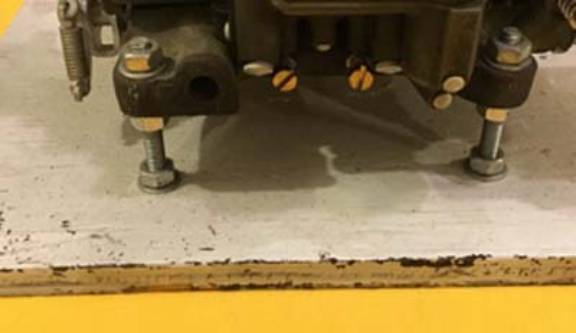
Pictured is one of my second generation homemade stands. This stand was made by taking a piece of 3/8 inch plywood (I now know that 1/2 inch is better - third generation), laying a flange gasket on the plywood to get the mounting pattern, drilling the holes, and inserting bolts. After drilling the holes, I counter-sink the bottom side (why the 1/2 inch works better), and then use flat head bolts (note the plywood sits flat on the table). Securely fasten the bolts to the plywood with flat washers and nuts, and using additional nuts, form an elevated "table" for the carburetor flange to mount. Once the carburetor is on the elevated table, another set of bolts holds the carburetor securely to the stand. Note that a stand such as this can even be used for single barrel (2 mounting bolt) carburetors, where one of the factory stands would allow the carburetor to wobble. Oh, and if you are wondering, my first generation stands used wooden rods fastened to the plywood. This proved to not be sufficiently substantial to do the job. Distribution This article, as with all other articles found on this website, have been written to place in the public domain and copied if desired. We only ask that you credit The Carburetor Shop LLC if/when you copy the article. |